How to Know When Your Drain Needs Professional Help
August 15, 2026
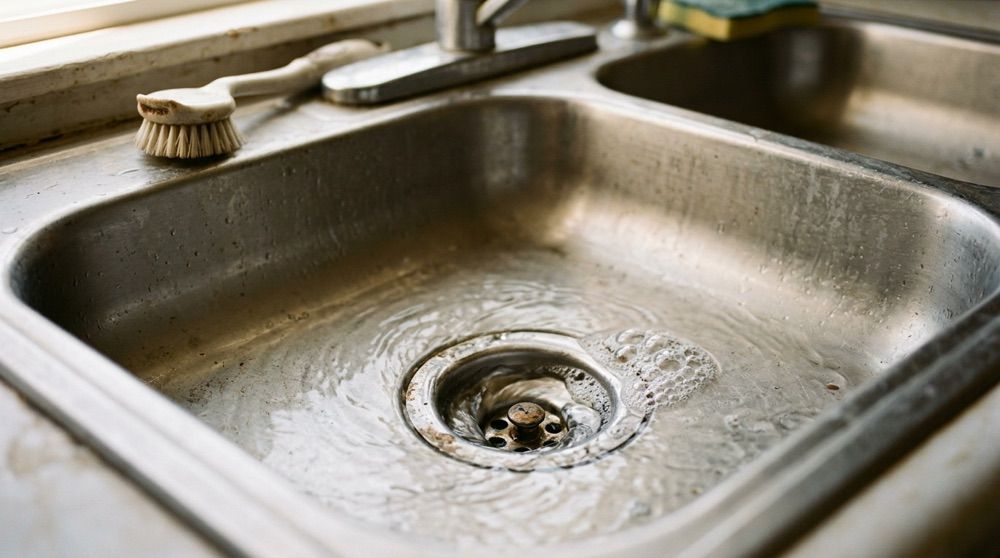
Knowing when to call a plumber for a clogged drain comes down to one question: is this a single, reachable clog, or a sign of something deeper? If a plunger or hot water clears one slow sink and it stays clear, you handled it. But when multiple drains slow at once, water backs up in the wrong fixture, you catch a sewage smell, or the same drain keeps clogging, stop — that pattern points past the trap, and it needs a professional.
Most homeowners can handle the small stuff, and you should. There's no honor in paying for a service call to fix what a plunger and a kettle of hot water would have solved in ten minutes. The trouble comes when a small clog gets treated like a small clog for weeks, while the real problem — grease buildup deep in the line, roots in an old lateral, a partial main blockage — keeps growing quietly underneath. This guide draws the line clearly: what you can safely try at home, the warning signs that mean stop and call, and what a professional does that you genuinely cannot do from your kitchen. We believe in fixing what can be fixed before tearing anything out, so we'll always tell you when the plunger is enough — and when it isn't.
What Can You Safely Clear Yourself?
You can safely clear a single, isolated clog with a plunger, near-boiling water, or an enzyme-based cleaner — anything that works on the clog you can reach without force or harsh chemistry. If one fixture drains slowly and everything else in the house runs fine, the blockage is usually close to the surface and fair game for DIY drain cleaning.
Start with the simplest tool. A good flat-bottom sink plunger or a flanged toilet plunger, used with enough water in the basin to cover the cup, solves a large share of everyday clogs through plain suction and pressure. For a greasy kitchen sink, a slow pour of hot — not boiling, if you have PVC — water can loosen a soft fat clog. Enzyme or bacterial drain cleaners work differently: they digest organic gunk over hours, so they're gentle on pipes and good for slow-building buildup and routine maintenance, though they're too slow for a fully stopped drain.
Here are the hard limits. Do not reach for a wire hanger or an aggressive hand auger in a fixture you can't see into — you can scratch finishes, punch through an old trap, or pack the clog tighter. Skip the caustic chemical drain cleaner entirely (more on why below). And if the clog doesn't yield to a plunger and hot water in a reasonable try or two, don't escalate the force. That's your cue that the blockage is deeper than these tools can safely reach — which is a different problem, not a bigger version of the same one.
Which Warning Signs Mean Stop and Call a Pro?
Stop and call a professional when the problem stops behaving like a single clog. The clearest red flags are multiple slow drains at once, a sewage smell indoors, gurgling from drains or the toilet, water backing up somewhere you didn't run any water, and a clog that keeps returning after you clear it. Any one of these points to a blockage in the main line or the sewer lateral — past the reach of a plunger and past the point where DIY helps.
Read these signs together, because they tend to travel in groups:
Multiple slow drains
When the tub, the bathroom sink, and the kitchen all drain sluggishly around the same time, the shared main line is likely restricted — not each fixture independently.
Sewage smell
A persistent sewage smell inside means gas that should be leaving through the vent or trap is finding its way back in, often from a blocked or compromised line. It's an air-quality and health concern, not just an unpleasant one.
Gurgling drain
A gurgling drain or a toilet that bubbles when a nearby fixture runs means air is trapped and venting the wrong way past a partial blockage.
Water backing up elsewhere
Flush the toilet and the shower drain rises? Run the washer and the floor drain floods? That "wrong fixture" backup is a hallmark of a main-line problem.
Recurring clogs
A drain you've cleared two or three times that clogs again is telling you the surface fix isn't reaching the real cause.
When water is actively backing up onto floors — especially if it looks or smells like sewage — treat it as a drain emergency, shut off water use in the house, and call. Continuing to run water only adds to what has nowhere to go.
Why Does the Same Drain Keep Backing Up?
The same drain keeps backing up because the clog you cleared was never the whole clog — you removed the tip of it while the body of the blockage stayed in the line. Recurring clogs almost always mean grease, soap, hair, or root intrusion has narrowed the pipe itself, so each "fix" only buys a little time before the restriction fills back in.
Kitchen lines are the classic repeat offender. Grease goes down warm and liquid, then cools and hardens on the pipe wall a few feet in, catching food and coffee grounds until the passage narrows to a trickle. A plunger clears the last inch; the greasy ring stays. In older homes, the pipe itself may be the problem — decades of scale, a bellied section that traps water, or a sewer lateral where tree roots have crept in through the joints, catching everything that passes. These aren't clogs you clear; they're conditions you correct.
Here in the Ohio Valley, we see a seasonal version of this play out every winter. Cooking fats and holiday-meal grease go down the kitchen drain, hit the cold run of pipe near an unheated crawl space or basement wall, and firm up fast — and in the older Steubenville-area homes with aging clay or cast-iron laterals, that hardened grease grabs onto already-rough pipe walls and root intrusions. The result is the same drain backing up again a few weeks after it was "fixed." It's a plausible, common pattern in river-corridor homes with original laterals, though the exact cause on any given property has to be confirmed on site. When you see that repeat pattern, the honest answer isn't another bottle of cleaner — it's finding out what's actually in the pipe.
What Can a Pro Do That You Can't?
A professional can see inside your pipes and clear the pipe wall itself — two things no home tool does. The core difference is diagnosis: instead of guessing at a clog you can't reach, a plumber locates the true blockage with a camera, then removes it at the source with equipment built for the job. That's the line between clearing a drain and actually fixing why it clogs.
A drain camera inspection sends a waterproof video head down the line so we can see exactly what's there — grease, roots, a collapsed section, a foreign object — and how far in it sits, before anyone commits to a repair. For buildup coating the pipe wall, hydro jetting uses high-pressure water to scour the line back toward its full diameter, which a cable auger can't do; the auger punches a hole through the clog, while jetting cleans the wall. And locating the true blockage matters as much as clearing it, because the fix for roots in a lateral is not the fix for a hardened grease ring, and the fix for a bellied pipe is different again.
This is also where DIY does real damage. Caustic chemical drain cleaner damage is the one we see most: those products generate heat and can soften or warp PVC, corrode older metal pipe, and sit in a standing clog doing harm without ever clearing it — then a plumber has to work in a line full of dangerous chemicals. They're a health hazard to you, too. Household cleaning substances are consistently among the top five categories of exposures reported to U.S. poison centers, with roughly 190,000 cleaning-substance exposures logged in 2022, according to America's Poison Centers — a reminder to keep the caustic bottle out of the equation for both your pipes and your family. Overzealous augering cracks traps and scratches fixtures. Our approach is repair, rebuild, replace, in that order — we look before we tear anything out, show you the options first, and fix what can be fixed. You can read more about how we handle these jobs on our drain cleaning service page, and when a backup can't wait, our 24-hour customer service line has a real person answering any hour.
The Bottom Line
Try the safe fixes first — a plunger, hot water, an enzyme cleaner on a single slow drain — and there's no shame in solving it yourself. But when the signs turn structural — multiple slow drains, a sewage smell, gurgling, water backing up where it shouldn't, or a clog that keeps coming back — that's the pipe telling you the problem is past the trap. Stopping at that point isn't giving up; it's avoiding the cracked trap, the chemical burn in your line, and the far bigger repair that comes from forcing it. Good plumbing means knowing which fixes are yours and which are ours, and being honest about the difference.
Frequently Asked Questions
Are chemical drain cleaners bad for your pipes?
They can be. Caustic and acidic drain cleaners generate heat and harsh reactions that can soften or warp PVC, corrode older metal pipes, and damage seals — and if the clog doesn't clear, that caustic liquid just sits in the line. They're also a serious burn and poisoning hazard to handle — the U.S. EPA classifies many drain openers as household hazardous waste for exactly that reason. For routine buildup, an enzyme cleaner or a plunger is far safer for both your pipes and you.
When is a clogged drain an emergency?
A clog becomes an emergency when water or sewage is actively backing up into your home, when multiple drains fail at once, or when a sewage smell fills the house — signs the main line, not one fixture, is blocked. Stop running water to keep the backup from spreading, and call for same-day help. Standing sewage is a health hazard, not just an inconvenience.
Why does my drain keep clogging even after I clear it?
Because the clog you cleared wasn't the whole problem. Recurring clogs usually mean grease, hair, scale, or tree roots have narrowed the pipe itself, so a surface fix only reopens a small channel that fills back in. A camera inspection shows what's actually in the line, and hydro jetting can clear the pipe wall so the clog stops returning.
Can I damage my pipes by snaking a drain myself?
Yes, you can. A hand auger or, worse, a wire hanger can scratch fixtures, crack an older trap, punch through corroded pipe, or pack a clog tighter if you force it into a bend you can't see. Light, careful use on a reachable clog is usually fine, but if it doesn't give easily, stop — forcing it often turns a small clog into a real repair.
By Anthony Joyce, Master Plumber & Founder, Joe's Better Plumbing.
Anthony Joyce is a master plumber and the founder of Joe's Better Plumbing, serving homeowners across the Ohio Valley from Steubenville, Ohio. He built the company on a simple conviction — that plumbing done with craftsmanship and honesty means repairing what others would rip out. Anthony and his team bring master-plumber standards, upfront options, and a real person on the phone to every home they serve.
a real person answers any hour, your appointment is confirmed within one business hour, and you'll see your options before any work begins.