The Complete Guide to Home Water Heaters for Ohio Valley Homes
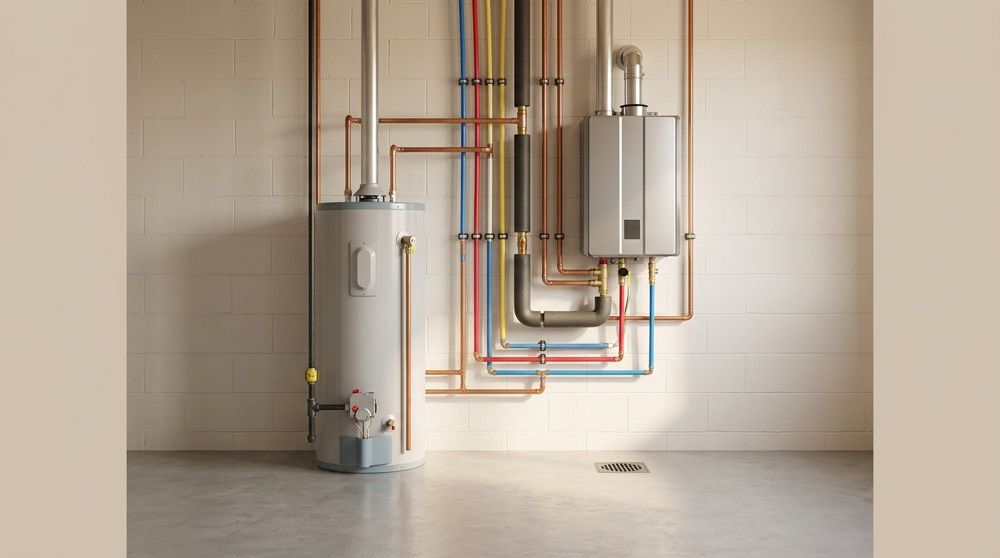
A home water heater supplies hot water to your taps, shower, dishwasher, and washing machine, and in most Ohio Valley homes it is either a storage-tank or tankless unit running on natural gas or electricity. This guide covers how each type works, what it costs, how long it lasts on our hard local water, and when to repair or replace it.
How a Home Water Heater Works
A water heater warms incoming cold water and then either stores it or delivers it on demand to every hot-water fixture in your home. In a storage-tank model, cold water enters an insulated tank of 40 to 80 gallons, a gas burner underneath or one or two electric elements inside bring it up to a set temperature, and a thermostat keeps it there until you open a hot tap.
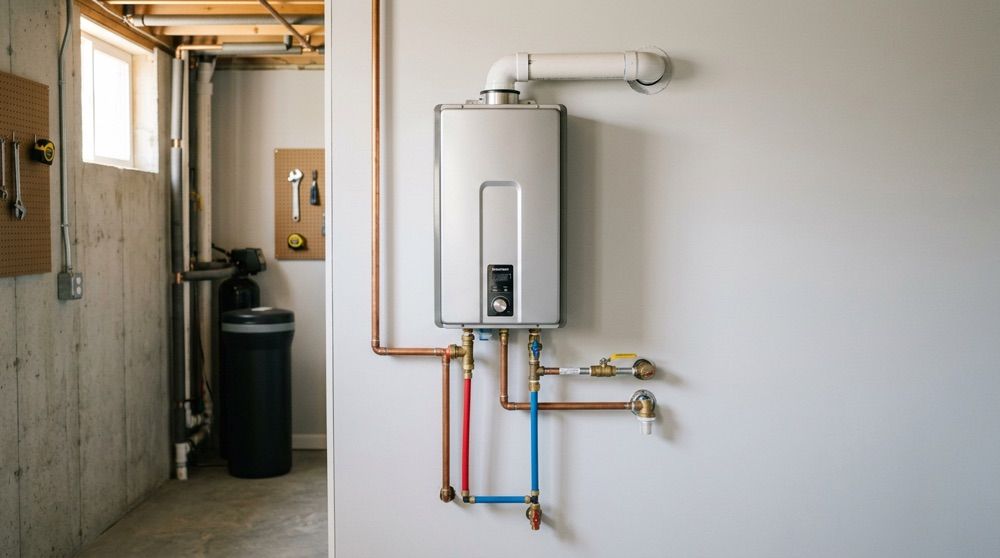
A tankless model works differently: it has no storage tank at all. When you turn on hot water, a flow sensor fires a powerful gas burner or bank of electric coils, and water is heated instantly as it passes through a heat exchanger. Both designs do the same job, but the trade-offs in cost, capacity, and lifespan are what make the choice matter for your household.
Two terms are worth knowing before you shop. Recovery rate is how quickly a heater can reheat a tank after it is drained, which is why a gas unit bounces back faster than an electric one of the same size. Standby loss is the small amount of heat a full tank sheds day and night, the reason a tankless unit, which stores nothing, edges out a tank on pure efficiency. Neither number tells the whole story alone, but together they explain why two heaters with the same gallon rating can behave very differently in a busy home.
Tank vs. Tankless: The Two Main Types
The two dominant designs are storage-tank and tankless, and each fits a different kind of home. A storage-tank heater is cheaper to buy and install, forgiving to service, and delivers a large burst of hot water quickly, but it holds a finite supply, so a long shower followed by a load of laundry can leave you cold. It also loses a little energy around the clock keeping that tank warm.
A tankless heater gives you effectively endless hot water, takes up a fraction of the space, and typically lasts far longer, but it costs more upfront and sometimes needs electrical or gas-line upgrades to support it. If you are weighing the two, our water heater repair and replacement service page lays out the tank and tankless options we install across the Steubenville and Weirton corridor. The right answer depends on your household size, your fuel, and your budget.
Gas or Electric: Which Fuel Fits Your Home?
The right fuel depends mostly on what your home already has and what you value most. A natural-gas water heater recovers hot water faster and usually costs less to run where gas is available, which is common on the built-up Ohio and West Virginia sides of the valley. An electric water heater costs less upfront, works in any home, and opens the door to a high-efficiency heat pump model.
Homes outside the gas mains, on wells and propane in the rural stretches around Bloomingdale, Richmond, or New Cumberland, often lean electric or propane by necessity. Switching fuels is possible but adds cost for new gas lines, venting, or electrical circuits, so it is worth pricing the full picture before you decide. A plumber can tell you quickly which fuel makes sense for your specific hookups.
Fuel choice also shapes what happens during a power outage. A standard gas tank with a pilot or thermopile can often keep making hot water when the electricity is out, while electric and most modern power-vented gas units stop until power returns. In a valley that sees winter storms roll down off the Ohio River, that difference is worth thinking about for a household that cannot easily go a day without hot water. We factor it into the recommendation when a home is prone to outages.
How Long Does a Water Heater Last in the Ohio Valley?
A conventional storage-tank water heater lasts about 8 to 12 years, while a well-maintained tankless unit can run 20 years or more. Those are national averages, though, and the naturally hard water across the Ohio Valley tends to push a tank toward the shorter end of that range as mineral scale builds up inside it.
The single biggest factor within your control is the anode rod, a sacrificial metal rod that corrodes so your tank does not. On hard water it can wear out in three to five years, and replacing it on schedule can add years to the heater's life. Water quality is the reason two identical heaters on the same street can fail years apart, which is why we treat local water conditions as part of every replacement conversation.
What Size Water Heater Does Your Home Need?
Sizing is about matching capacity to your peak demand, not just the number of people in the house. For a storage tank, the key number is the first-hour rating, which measures how much hot water it can deliver during a busy morning. For a tankless unit, the number that matters is flow rate in gallons per minute, or how many fixtures can run hot at once.
As a rough guide, a one-to-two-person home is usually served by a 30-to-40-gallon tank, a family of three or four by a 40-to-50-gallon tank, and a larger household by 50 to 80 gallons or a high-output tankless. Get it wrong in either direction and you pay for it, either in cold showers or in wasted standby energy heating water nobody uses.
Sizing a Tankless Unit for Ohio Valley Winters
Tankless sizing hinges on two numbers working together: how many gallons per minute you need at once, and how far the unit has to raise the incoming water temperature to reach a comfortable 120 degrees. That second number, called temperature rise, is where our climate changes the math. A single showerhead draws roughly 1.5 to 2.5 gallons per minute, a kitchen faucet about 1.5, and a washing machine around 2, so a household that showers while the dishwasher runs can easily ask for 4 to 5 gallons per minute of hot water at peak.
The catch is that a tankless heater's rated flow assumes warm incoming water. In the depth of an Ohio Valley winter, groundwater entering the home can drop to the mid-40s, forcing the unit to lift the temperature by 70 to 75 degrees rather than the 40 or 50 degrees it manages in summer. That larger rise cuts a tankless unit's effective output, sometimes nearly in half, so a heater that keeps up in July can lag in January. This is exactly why we size tankless units to winter conditions, not the spec-sheet maximum, and often recommend a higher-output model or a pair of smaller ones for a busy household. Undersizing here is the single most common reason homeowners complain that their tankless water "runs cool" when demand spikes.
The Real Cost of a Water Heater
The true cost of a water heater is three numbers, not one: the purchase price, the installation labor, and the energy it burns for a decade or more. That last number is larger than most homeowners expect. According to the U.S. Department of Energy in its April 2024 efficiency-standards announcement, water heating is responsible for roughly 13 percent of a home's annual energy use and utility costs.
That same DOE action is projected to save American households about 7.6 billion dollars a year once the standards take full effect in 2029, largely by pushing electric buyers toward heat pump models. The takeaway for your budget is simple: a cheaper heater that runs inefficiently for ten years often costs more in the end than a pricier, efficient one. It pays to look at the operating cost, not just the sticker.
Efficiency Ratings: UEF and First-Hour Delivery
Every water heater sold today carries a Uniform Energy Factor, or UEF, printed on its yellow EnergyGuide label. The higher the UEF, the more of the fuel it burns actually ends up in your hot water rather than lost to the flue or the tank walls. A standard gas tank might sit around 0.60, a high-efficiency condensing gas unit closer to 0.90, and an electric heat pump well above 3.0 because it moves heat rather than generating it directly.
UEF only means something when you compare units of the same type and size, so read it alongside the first-hour rating on a tank or the rated flow in gallons per minute on a tankless model. A heater with a great efficiency number that is too small for your household will still leave you short. Matching the size to your real demand and then choosing the most efficient unit in that size is how you land on the lowest lifetime cost.
Repair or Replace: Reading the Warning Signs
Some water heater problems are quick repairs, while others are the unit telling you its time is up. A failed thermostat, a burned-out heating element, a bad thermocouple, or a leaking valve are usually straightforward, affordable fixes on a heater that still has life left in it.
Replacement signals are different. Rusty or brown hot water, a rumbling or popping tank, moisture or corrosion around the base, water that never gets fully hot, and an age past ten years all point toward the end of service life, especially when they appear together. Water pooling under the tank almost always means the inner shell has corroded through, and that cannot be patched. When repairs start stacking up on an older unit, replacement is usually the more economical path.
A useful rule of thumb we share with homeowners is the fifty-percent test: if a repair would cost more than half the price of a new unit, and the heater is already near the end of its expected lifespan, the money is better spent on replacement. A newer unit is more efficient, comes with a fresh warranty, and removes the risk of a sudden failure that floods a finished basement. We will always tell you honestly which side of that line your heater falls on, because a repair that buys another good year is often the smarter call.
How Hard Water Shortens Water Heater Life in the Ohio Valley
Hard water is one of the biggest local threats to a water heater in our area. As water is heated, dissolved calcium and magnesium drop out of solution and settle as a rock-hard scale on the bottom of a gas tank or across the electric elements. That scale acts like insulation, forcing the burner to run longer and hotter, which wastes energy and stresses the steel.
Over time, scale leads to overheating, popping noises, and premature tank failure, and it clogs the narrow passages inside a tankless heat exchanger. Treating the water before it reaches the heater is the most effective defense, which is why many homeowners pair a new unit with whole-house water filtration and softening to protect the investment. Softer water also keeps fixtures, dishwashers, and washing machines running longer.
Tankless heaters are especially sensitive to hard water, which is why most manufacturers require an annual descaling to keep the warranty valid. On untreated Ohio Valley water, that maintenance is not optional, and skipping it is one of the most common reasons a tankless unit underperforms or fails early. If you are considering tankless, budget for either a softener or a scheduled descaling service from the start, and think of it as part of the cost of ownership rather than an add-on.
Maintenance That Extends Your Water Heater's Life
A water heater rewards a little routine care with years of extra service. The core tasks are simple: flush the tank once a year to clear sediment, inspect the anode rod every few years and replace it when it is mostly consumed, and test the temperature-and-pressure relief valve to make sure this critical safety device still opens.
It also helps to keep the thermostat at a sensible setting, insulate exposed hot-water pipes, and keep the area around a gas unit clear for proper combustion air. On hard Ohio Valley water, an annual flush matters even more because sediment accumulates faster. Most homeowners find it easiest to fold these tasks into one yearly visit rather than tracking them separately.
Water Heater Safety: Venting, Relief Valves, and Carbon Monoxide
A water heater is a safe appliance when it is installed and maintained correctly, but it deserves respect because it combines heat, pressure, and, on gas models, combustion. The temperature-and-pressure relief valve is the most important safety device on the unit: it opens to release pressure if the tank ever overheats, preventing a dangerous rupture. It should be tested periodically and never capped or blocked.
Gas units add a second concern, which is proper venting of exhaust. A blocked or disconnected vent can allow carbon monoxide, an odorless gas, to spill back into the home, so every household with a gas heater should have working carbon monoxide detectors nearby. If you ever notice soot around the burner, a pilot that will not stay lit, or a faint gas smell, shut the unit down and call a professional rather than troubleshooting it yourself. These are the situations where a licensed plumber earns their keep.
What a Water Heater Replacement Involves
A straightforward tank-for-tank swap is usually a few hours' work, but a proper replacement is more than lifting out the old unit and dropping in a new one. The plumber drains and disconnects the failed heater, hauls it away, and then brings the new installation up to current code, which in both Ohio and West Virginia often means adding parts the old setup lacked. A thermal expansion tank is now commonly required on systems with a backflow preventer, a drip pan with a routed drain is expected when the heater sits above a finished space, and gas models need their venting inspected and, if needed, corrected.
Switching types adds steps. Moving from a tank to tankless usually means a larger gas line and new venting; going to a heat pump model needs adequate air volume around the unit and a condensate drain. Most jurisdictions in the valley require a permit and an inspection for a water heater replacement, and a licensed plumber pulls that permit as a matter of course. It is worth asking any contractor whether their quote includes the permit, the code upgrades, and haul-away, because a suspiciously low bid often leaves those out and passes the cost and the liability back to you.
When to Call a Master Plumber
You can handle small maintenance yourself, but installation and gas work belong with a licensed professional. Water heater installs involve gas lines, combustion venting, electrical circuits, and local permits in both Ohio and West Virginia, and a mistake can mean a leak, a carbon monoxide risk, or a code violation that voids the manufacturer's warranty.
That standard is exactly why the company was built the way it was. You can read the story behind Joe's Better Plumbing and the master-plumber approach we bring to every home. If your hot water is failing, or you simply want an honest assessment of whether to repair or replace, a professional evaluation costs you nothing but a phone call and can save you from an expensive emergency later.
Talk to a Master Plumber About Your Water Heater
Whether you need a repair today or you are planning ahead for a replacement, we will give you straightforward options and upfront pricing, never a hard sell. Call Joe's Better Plumbing at 740-202-9920 or contact Joe's Better Plumbing to schedule a visit anywhere in the Steubenville and Weirton corridor. We would rather save your unit than sell you one.
Frequently Asked Questions
Is a heat pump water heater worth it for an Ohio Valley home?
For many Ohio Valley homes, yes. A heat pump, or hybrid, water heater uses roughly two to three times less electricity than a standard electric tank, and under the U.S. Department of Energy's 2024 standards it becomes the efficient default for electric units by 2029. It costs more upfront and works best in a conditioned basement or utility space with room to breathe.
How often should I flush my water heater?
Most manufacturers recommend flushing a storage tank once a year to clear sediment, and homes on hard Ohio Valley water often benefit from doing it twice a year. Flushing drains the mineral buildup that insulates the burner or element, wastes energy, and shortens the tank's life. It is easy to fold into an annual service visit with your plumber.
Can I install a water heater myself?
We do not recommend it. Water heater installation involves gas lines, venting, electrical connections, and local permits, and mistakes can cause leaks, carbon monoxide exposure, or code violations that void your warranty. In Ohio and West Virginia, gas and larger electric installations typically require a licensed plumber. Professional installation also keeps your manufacturer warranty intact.
What temperature should I set my water heater to?
120 degrees Fahrenheit is the standard recommendation. It is hot enough for cleaning and bathing, low enough to reduce scald risk and slow scale buildup, and it saves energy compared with a 140-degree setting. Homes with immune-compromised residents sometimes set it a bit higher to limit bacteria, so ask your plumber about the right balance for your household.
Anthony Joyce is a master plumber and the founder of Joe's Better Plumbing, serving homeowners across the Ohio Valley from Steubenville, Ohio. He built the company on a simple conviction, that plumbing done with craftsmanship and honesty means repairing what others would rip out. Anthony and his team bring master-plumber standards, upfront options, and a real person on the phone to every home they serve.
Recent Posts