The Complete Guide to Better Water Quality for Ohio Valley Homes
August 1, 2026
Better water quality for Ohio Valley homes starts with knowing what's actually coming out of your tap. Along the Ohio and West Virginia river corridor, most homes deal with some mix of hard water, chlorine, sediment, and — on private wells — iron, manganese, or other contaminants. The fix is not guesswork: test first, then choose filtration, softening, or conditioning to match your water.
If you've noticed spots on the glasses, a crust building on the faucet, or a faint chlorine smell when you fill a pot, you're already reading the signs. None of that means your water is unsafe. It usually means your water is hard, or carrying minerals and treatment chemicals that municipal systems and local geology hand every home in this valley. Understanding what's in the water — and what it's quietly doing to your fixtures, pipes, and water heater — is the first step toward fixing it the right way, once, instead of chasing symptoms for years.
This guide walks through it the way we'd explain it standing in your kitchen: what's in the water here, what it costs you over time, and how to decide between a softener, a filter, or both. We build on the idea that you should fix what can be fixed before tearing anything out — so we'll tell you when a simple correction is enough and when it's time to bring in a master plumber.
What's Actually in Ohio Valley Water?
Ohio Valley water is generally safe to drink but hard, and often carries chlorine, sediment, and — on wells — dissolved metals. The specific mix depends on whether you're on a municipal supply or a private well, and on the limestone and mineral-rich geology the rivers cut through.
Here in the Steubenville–Weirton river corridor, water travels through and over calcium- and magnesium-bearing rock before it ever reaches a treatment plant or a well casing. Those two minerals are what "hardness" measures. Municipal systems then add chlorine (or chloramine) to keep the water safe from the plant to your tap, which is why treated city water can carry a chemical taste or smell. Along the way, water also picks up sediment — fine silt and rust particles — that you'll sometimes see as cloudiness after a main break or a hydrant flush.
Private wells are a different story. Well water in and around Steubenville skips municipal chlorination but can pick up iron and manganese from the ground, which show up as orange-brown or blackish staining on fixtures and laundry. Wells can also carry hardness, hydrogen sulfide (a "rotten egg" smell), and, depending on the site, bacteria or nitrates. That's why a water heater problem on a well property so often traces back to water chemistry, not the appliance. The only way to know your specific mix is to test — which we cover below.
It's worth putting a name to the usual suspects, because most Ohio Valley homes see some combination of these. Hardness (calcium and magnesium) is nearly universal here. Chlorine or chloramine shows up on every municipal supply. Sediment — fine silt, sand, and flakes of rust from aging mains — comes and goes with weather and water-main work. Iron and manganese are mostly a well-water concern, but they leave the most stubborn stains. And on some properties you'll find hydrogen sulfide, low pH, or elevated nitrates. None of these are exotic; they're the ordinary chemistry of living in a river valley built on limestone. What matters is which ones *your* home has, and in what amounts — because that's what separates a home that needs a simple filter from one that needs a full treatment train.
Is Ohio Valley Water Hard? (And What "Hard" Really Means)
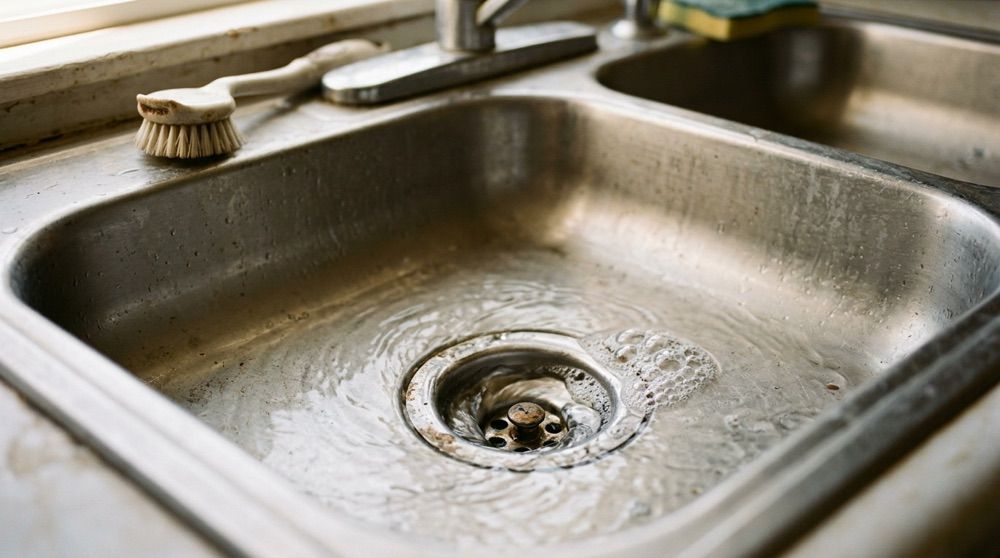
Yes — most Ohio Valley water is moderately hard to very hard, meaning it carries a high concentration of dissolved calcium and magnesium. "Hard water Ohio Valley" is one of the most common searches from homeowners here, and the everyday signs — spotting, soap that won't lather, chalky buildup — are the visible result of those minerals.
The U.S. Geological Survey classifies water hardness by the amount of dissolved calcium carbonate it contains. According to the USGS, water measuring 0–60 mg/L as calcium carbonate is soft, 61–120 mg/L is moderately hard, 121–180 mg/L is hard, and anything above 180 mg/L is very hard. Plumbers and softener installers often use "grains per gallon" (gpg) instead — one grain equals about 17.1 mg/L — so a reading of 180 mg/L is roughly 10.5 gpg.
Why does this matter to you specifically? Because hardness is what determines whether a softener earns its keep in your home. Water in the low "moderately hard" range may only need targeted filtration for taste and odor. Water pushing into the "very hard" band is the kind that scales up a water heater, stiffens laundry, and shortens the life of every fixture in the house. You don't have to guess where you land — a simple test gives you the number, and the number drives the decision.
What Hard and Aggressive Water Does to Your Home
Hard water leaves mineral scale that builds up inside pipes, fixtures, and water heaters, while "aggressive" (corrosive) water does the opposite — it slowly eats at metal pipes and fittings. Both shorten the life of your plumbing, and both cost you money quietly, over years, before anything actually breaks.
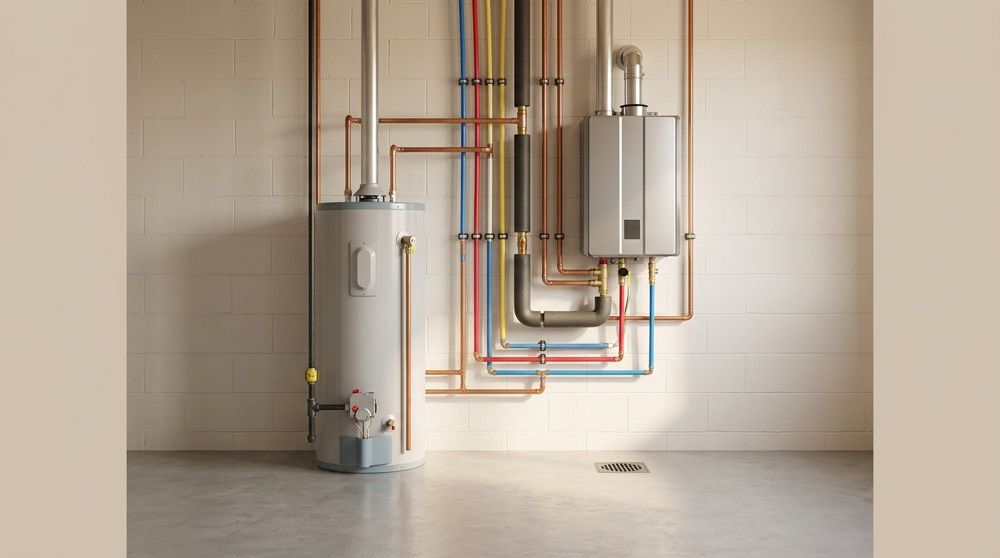
Scale is the one most people see. As hard water is heated or left to sit, calcium and magnesium drop out of solution and cling to surfaces as a hard, chalky crust. On a faucet aerator it's an annoyance. Inside a water heater it's a real expense: a layer of scale on water heater surfaces acts like an insulating blanket over the burner or element, forcing the unit to run longer and hotter to heat the same water. The U.S. Department of Energy notes that sediment and scale buildup reduce a water heater's efficiency and can shorten its service life, which is why hard-water homes often replace heaters years earlier than they should.
Aggressive water works the other direction. Low-pH or low-mineral water — more common on some wells — can slowly corrode copper and galvanized steel from the inside, leaving blue-green staining, pinhole leaks, and eventually pipe failure. It's the same reason we always want to know your water chemistry before recommending pipe work: the right plumbing services plan for scaling water is different from the plan for corrosive water. Treating the water protects the investment you've already made in the pipes behind your walls.
The costs add up in places you don't always connect to the water. Fixtures wear out faster as scale chews through washers and clogs aerators. Dishwashers and washing machines strain against mineral buildup and use more detergent to get the same result. Faucets and showerheads clog and drip. And because scale is an insulator, every degree your water heater has to overcome a mineral crust is energy you pay for on the utility bill month after month. Individually these are small; together, over the ten-to-fifteen-year life of a home's plumbing, hard water quietly becomes one of the more expensive problems a homeowner never thinks to name. The good news is that it's also one of the most preventable — which is exactly why we'd rather treat the water than keep replacing what the water damages.
Do I Need a Water Softener, a Filter, or Both?
It depends on what's in your water: a softener removes hardness minerals, a filter removes contaminants like chlorine, sediment, iron, or bad taste and odor — and many Ohio Valley homes benefit from both, in sequence. The "water softener vs filter" question is really two different jobs, not one choice.
A water softener addresses hardness and only hardness. It uses ion exchange to swap calcium and magnesium for sodium (or potassium), which stops scale from forming, protects your water heater, and makes soap lather properly again. What a softener does *not* do is improve taste, remove chlorine, or filter out sediment and metals.
A filter addresses everything else. Depending on the media, a whole-house or point-of-use filter can strip chlorine and its taste and smell, capture sediment, or reduce iron and manganese staining. What a filter does *not* do — with rare exception — is soften water; it won't stop scale.
So the honest answer for a lot of homes here is "both, in the right order": a filter to handle chlorine and sediment, and a softener downstream to handle hardness. But the only way to know which components you actually need — and to avoid paying for equipment that solves a problem you don't have — is to test first. A well home with iron staining needs a very different build than a city home that just wants the chlorine taste gone. Our water filtration and softening work always starts with matching the system to the water, not the other way around.
What About Chlorine Taste and Smell?
That chlorine taste and smell comes from the disinfectant municipal systems add to keep water safe on its way to your home — it's a sign the water is treated, not a sign it's contaminated. If it bothers you, it's one of the easiest water-quality complaints to fix.
Chlorine (and chloramine, a longer-lasting variant some systems use) does an important job: it keeps water free of harmful microbes from the treatment plant all the way to your tap. The trade-off is the swimming-pool taste and odor many Ohio Valley homeowners notice, especially in warmer months or right after a system flush. It's aesthetic, not dangerous — but it also affects how your coffee, tea, and drinking water taste, and it can be hard on sensitive skin.
The fix is filtration matched to the chemical. A carbon-based filter — whether a whole-house unit or a simpler under-sink or countertop setup — is very effective at reducing chlorine taste and smell. Chloramine is more stubborn and needs a specific catalytic carbon media to remove it well, which is one more reason testing (and knowing what your utility uses) matters before you buy. This is a good example of "repair before replace" thinking: you don't need a whole treatment system to solve a taste problem a targeted filter handles cleanly.
How Do I Find Out What's in My Water?
Test it. A water test tells you exactly what's in your home's water — hardness in gpg or mg/L, chlorine, iron, manganese, pH, and more — so you can treat the actual problem instead of guessing. Testing is the single most important step in this entire guide, and it's the step most homeowners skip.
If you're on municipal water, your utility is required to publish an annual Consumer Confidence Report (water quality report) that lists what's in the supply at the plant. That's a useful starting point, but it describes the water leaving the treatment facility — not the water arriving at your specific tap after traveling through mains and your home's own pipes. Hardness, in particular, is often not fully captured there.
For a true picture, you want a test of the water at your home. That can be a certified lab test (the gold standard, and the right call for wells, where the EPA recommends annual testing for bacteria and nitrates), or an in-home professional test that reads hardness, chlorine, iron, pH, and sediment on the spot. Well owners especially should test on a schedule, since well water quality can change with the seasons, nearby land use, and the age of the well. Once you have real numbers, the softener-versus-filter decision practically makes itself — and you avoid buying equipment you don't need.
Testing also gives you a baseline to measure against later. If a stain appears, the taste changes, or a new water heater starts scaling early, a follow-up test tells you what shifted instead of leaving you to guess. It's the same principle a good plumber applies to any system: measure before you touch anything, so the work that follows is aimed at the real problem rather than a symptom. A twenty-minute test at the start of the process is the cheapest insurance a homeowner can buy against a wrong, expensive fix.
When Is a Master Plumber Needed?
Bring in a master plumber when you're installing whole-house treatment, tying into your main water line, dealing with a well system, or seeing signs of pipe corrosion or repeated water-heater failure. Simple point-of-use filters you can often handle yourself; anything that touches your home's main plumbing deserves professional work.
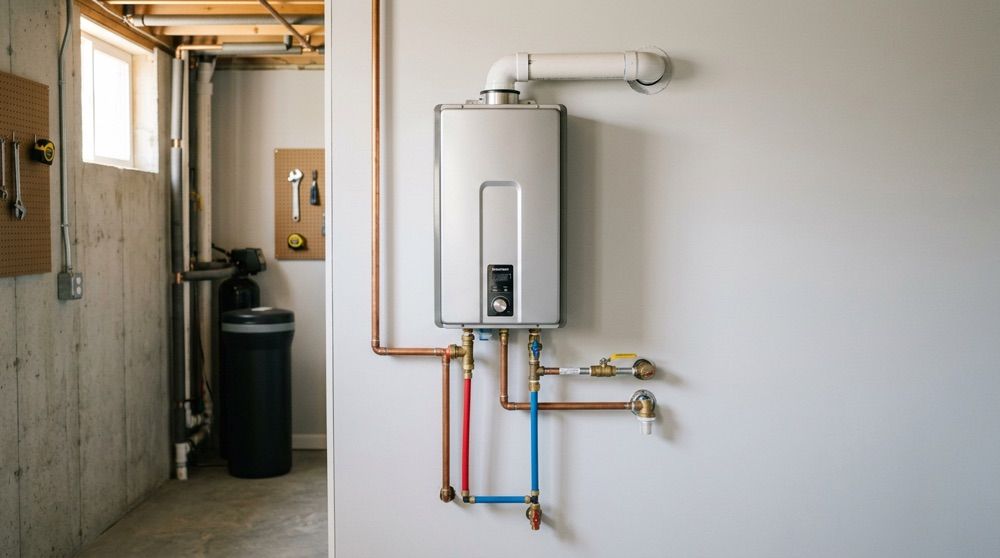
The line is really about where the work happens. A countertop pitcher or a screw-on faucet filter is a homeowner job. But a whole-house softener or filter has to be plumbed into your main line, sometimes with a bypass loop, a drain connection for backwashing, and correct sizing for your household's flow rate. Undersize it and you lose water pressure; oversize it and you waste money and salt. Well systems add pressure tanks, pumps, and sometimes disinfection into the mix — none of it forgiving of a rushed install.
There's also the diagnostic side. If your water heater keeps failing early, or you're seeing corrosion, staining, or pinhole leaks, the smart move is to have someone read the whole system — water chemistry, pressure, pipe material, and equipment condition — before spending money. That's the honest, "repair, rebuild, replace" approach: we look for what can be fixed before recommending anything torn out. When treatment or repiping is genuinely the right call, master-plumber craftsmanship is what makes it last. If you're unsure where your situation falls, book a plumber and we'll tell you straight.
A Real Ohio Valley Example
Consider a typical scenario on the West Virginia side of the river, in the Weirton–Follansbee stretch: a family notices their three-year-old water heater is already rumbling and slow to recover, the shower door has a permanent chalky film, and the coffee tastes faintly of chlorine. Nothing is broken — but everything points to hard, chlorinated municipal water doing its slow work.
A test confirms it: hardness in the "very hard" range and a measurable chlorine level. The right build here isn't one gadget — it's a carbon filter to take out the chlorine taste and smell, and a properly sized softener downstream to stop the scale that's cooking that water heater early. Flush the scale from the heater, treat the water feeding it, and that same appliance suddenly lasts the way it was designed to. That's the difference testing makes: the money goes to the actual problem.
Municipal supplies along the Steubenville–Weirton corridor draw from the Ohio River watershed and its mineral-rich geology, so hardness in this range is a plausible and common finding here — though the exact figures vary by community and season, which is exactly why we test each home rather than assume.
The Bottom Line for Ohio Valley Homeowners
Better water quality for Ohio Valley homes comes down to a simple sequence: test what's in your water, treat the specific problems you actually have, and protect the plumbing you've already paid for. Hard water and chlorine are the norm here, not the exception — and both are very fixable once you know your numbers.
You don't need to be talked into the biggest system on the truck. Sometimes a targeted carbon filter solves the taste. Sometimes a softener saves a water heater. Often it's both, sized right and installed to last. The point is to match the solution to the water — do good work, do it with care, and fix what can be fixed before replacing it. Better water really does mean better life, and it starts with a test.
Frequently Asked Questions
Is the water in the Ohio Valley hard?
Yes. Most Ohio Valley water — including the Steubenville and Weirton river-corridor communities — ranges from moderately hard to very hard because it moves through calcium- and magnesium-bearing rock before reaching your tap. The everyday signs are spotting on glasses, poor soap lather, and chalky scale on faucets and fixtures. A quick water test tells you your exact hardness so you can treat it correctly.
What's the difference between a water softener and a water filter?
A water softener removes hardness minerals (calcium and magnesium) through ion exchange, which stops scale and protects your water heater. A water filter removes other things — chlorine, sediment, iron, manganese, or bad taste and odor. They do different jobs, so many Ohio Valley homes use both: a filter for contaminants and a softener downstream for hardness.
Does hard water damage my water heater and pipes?
Yes, over time. Hard water leaves mineral scale that builds up inside pipes and coats the inside of your water heater, making it run longer, cost more to operate, and often fail years early. Aggressive or corrosive water can eat metal pipes from the inside, causing staining and pinhole leaks. Treating the water protects both.
How do I find out what's in my home's water?
Test it. If you're on city water, start with your utility's annual water quality report, then confirm with an at-home test for hardness, chlorine, and iron. If you're on a well, get a certified lab test — the EPA recommends testing wells annually for bacteria and nitrates. A professional in-home test reads your key numbers on the spot.
By Anthony Joyce, Master Plumber & Founder, Joe's Better Plumbing.
Anthony Joyce is a master plumber and the founder of Joe's Better Plumbing, serving homeowners across the Ohio Valley from Steubenville, Ohio. He built the company on a simple conviction — that plumbing done with craftsmanship and honesty means repairing what others would rip out. Anthony and his team bring master-plumber standards, upfront options, and a real person on the phone to every home they serve.
Book a Plumber — a real person answers any hour, your appointment is confirmed within one business hour, and you'll see your options before any work begins.